 ORIN
ORINContents
- Abstract
- 1 Purpose and scope
- The problem with oral-insulin news
- Historical pattern: when the narrative outran the evidence
- Root cause: where the incentive to check runs out
- The agent advantage, and its limits
- The economic value of acceleration
- Participants and the path to patients
- 2 The scale of the question
- 3 How the network produces useful work
- 4 ORIN and the NEWS protocol
- 5 The proposed launch band
- 6 Implementation and launch readiness
- References and document basis
- Inferred positions in this draft
Abstract
A viable oral insulin reaching patients earlier could add years of treatment value and commercial activity, while wider access could extend that value to more people. ORIN is the proposed project token for a neutral network designed to help researchers, developers, manufacturers, clinicians, payers, channels and capital act on the evidence needed to advance that opportunity.
Oral insulin has been pursued for decades. Published reviews list between eight and twelve oral programs that reached clinical trials, and no approval by a major regulator. The two non-injected insulins that were approved were inhaled; one was withdrawn within two years and the other remains a niche product. One oral insulin matched an injected basal insulin in a controlled trial and was stopped because its dose made it uneconomic. Over the same period other peptides reached approval by mouth. Throughout, the public account of the category has run ahead of its evidence: approvals known only from company statements, phase 2 signals that did not survive phase 3, and one word, oral, covering routes with different physiology. The first half of this paper documents that pattern and where it comes from. The second half describes a network built to correct it. [5, 7, 10]
The network applies the NEWS protocol thesis to the oral-insulin industry: foresight improves which opportunities participants recognize, the capacity to act turns knowledge into development and delivery, and network coordination connects complementary resources. Their combined effect is measured through the value generated over time. The intended contribution is acceleration toward a viable solution and its adoption, whichever developer succeeds. Acceleration remains a hypothesis to test, not a result already achieved. [1, 11, 14]
wNEWS is intended to support the launch through the initial ORIN/wNEWS market. ORIN is intended to support subsequent participation, staking and compensation within the project. The precise staking, reward and settlement rules remain to be defined; section 4 sets out an inferred scheme, in italics, for the owner to accept, amend or reject. The liquidity model described here is a simulation of a proposed launch configuration, not evidence that the token or its staking system has been deployed. [3, 4]
1 Purpose and scope
OralInsulin asks three connected questions: What would a working oral insulin change? Which candidates exist, and what does the public record establish about them? What would it take for a candidate to succeed technically and commercially? The beneficiary could be a patient, researcher, manufacturer, payer, health system or government. The network remains open to advances from academic programs, ventures and established pharmaceutical companies. [1]
The scope includes swallowed, buccal, sublingual and other oromucosal insulin approaches. These routes retain separate classifications. Inhaled insulin and adjacent metabolic therapies may serve as comparators; they are not automatically counted as oral-insulin candidates. An oral insulin used for immune tolerance also requires separate classification from insulin intended for systemic glucose control. [1, 5]
ORIN coordinates work around the category. No particular developer is designated the winner. Any rights to intellectual property, drug revenue, equity or redemption would require separate explicit terms; this draft defines none.
The problem with oral-insulin news
The public record of a drug category should let a reader answer three questions: what has been shown, in whom, and by what route. Much of what circulates about oral insulin does not. A trial registration is reported as a pipeline. A company statement is reported as an approval. A phase 2 signal is reported as a product. The NEWS protocol whitepaper describes the same structure in finance: information that people act on as fact while it remains interpretation. [15] Four features of this category make the gap wide.
One word for several routes
The word oral is applied to insulin that is swallowed, insulin absorbed through the cheek or under the tongue, and insulin given by mouth to induce immune tolerance rather than to lower glucose. These differ in physiology, in what must be proven and in who would use them. A keyword retrieval from ClinicalTrials.gov on September 18, 2026 returned 58 studies from 19 sponsors, against 89 that the registry reports. Its verbatim rows include swallowed capsules, a buccal spray, oral insulin studied in type 1 and stage 1 type 1 diabetes, an injected hepatic-directed insulin, a metformin study in pregnancy, and oncology combinations from a sponsor that also ran oral insulin trials. The draft registry therefore marks route and mechanism as unverified on every row until a named verifier classifies each from its intervention text. A count of oral-insulin trials taken from such a search is a count of search results. [5]
Approvals without a regulator’s record
The buccal spray Oral-lyn is widely described as approved in Ecuador, India, Lebanon and Algeria. The September 18 field review located no national regulator’s register entry for any of the four; every approval statement traces to company releases and their repetition in trade press. The company’s own 2012 prospectus stated the approvals, the Indian one subject to further study, expected no significant revenue from them, and reported an accumulated net loss of USD 357.6 million. No peer-reviewed publication of the pivotal data was located, and no published figure for bioavailability, dose ratio or variability. The buccal route’s most cited existence proof left almost no usable numbers. [5, 7, 25]
Signals that did not survive scale
ORMD-0801, a swallowed capsule, showed greater HbA1c reduction than placebo in peer-reviewed phase 2 studies. Its 26-week phase 3 trial in 710 patients, reported on January 11, 2023, met neither its primary endpoint nor its secondary endpoint, and the second phase 3 trial was terminated. When the registry was read on September 18, 2026 it listed a further phase 3 study of the same compound as not yet recruiting. [5, 22]
Figures quoted without their scope
The scenario presets published on the site imply class revenue of USD 146 million to USD 3.5 billion. The September 18 market band, anchored on what happened when oral drugs matched injectables in other categories, gives USD 10.8 billion to USD 31.3 billion from the same market input. Neither is a forecast. The difference is one assumption, class share, and the earlier presets carried no source for it. The insulin market itself is carried at USD 19.4 billion in the project record and at DKK 169 billion in a manufacturer’s presentation of third-party data at list prices; the two are on different bases and cannot be set side by side without saying so. [7, 14, 28]
| What circulates | What the record supports | Basis |
|---|---|---|
| Buccal insulin is approved in four countries | Company statements only; no regulator’s register entry was located | [5, 25] |
| Oral insulin lowered HbA1c in trials | In phase 2. The 710-patient phase 3 trial missed both endpoints | [5, 22] |
| Oral insulin does not work | An oral basal insulin matched injected glargine on fasting glucose over eight weeks, then was stopped on dose and cost | [21] |
| Oral peptides are a solved problem | Oral semaglutide is approved; in 2025 it was under a tenth of its molecule’s sales (arithmetic on company figures) | [7, 28] |
| Patients prefer a pill | 76.5 percent in the abstract; 52.5 percent after seeing the administration steps | [32] |
| A pill will be taken more reliably | No study was located linking a change of insulin route to adherence or cost | [7] |
The corrections run in both directions. The third row matters most for what follows: the strongest controlled result in the category was positive, and the program ended for an economic reason. The stakes are practical. Capital, trial participants and years are committed on accounts like those in the left-hand column. Section 2 gives the scale of the need; the history below shows what the gap has cost.
Historical pattern: when the narrative outran the evidence
The NEWS whitepaper reads three financial crises through the same questions: what signal was believed, what was true, and how it ended. [15] The same questions fit six episodes in non-injected insulin and one adjacent success. All figures come from the September 18 research drafts and the sources they cite. Where a figure rests on a secondary source, or was not verified in the agent review, that is stated. [5, 7, 20]
Exubera, 2006 to 2007: approval is not adoption
Believed signal. An inhaled insulin, Exubera, received FDA approval on January 27, 2006, with European authorization the same year. That month Pfizer agreed to pay USD 1.3 billion for its partner’s share of worldwide rights. Press coverage at the withdrawal reported that annual sales above USD 1.5 billion had been projected (secondary source).
What the record showed. The label put peak serum insulin at 49 minutes and described within-subject variability as generally comparable to injected regular insulin. The pharmacology was not the failure. Later commentary names lung-function concerns, cumbersome dose conversion, a bulky device and improved injection pens.
Outcome. On October 15, 2007 Pfizer decided to exit and recorded pre-tax charges of USD 2.8 billion, stating that the product had not gained the acceptance of patients and physicians. A later review records that other developers of inhaled insulin stopped after the withdrawal. [5, 7, 10, 23]
Afrezza, 2014 onward: a route carries its own obligations
Believed signal. A second inhaled insulin was approved on June 27, 2014, five years after its application, following an earlier action letter and a resubmission. It reaches peak concentration in 10 to 20 minutes.
What the record showed. The label requires lung-function testing at baseline, after six months and annually thereafter, and contraindicates use in chronic lung disease. The route itself generated a permanent monitoring requirement.
Outcome. The marketing partner withdrew from a USD 925 million agreement in January 2016 (secondary source). The project record carries 2025 net revenue of about USD 74.6 million, and the developer’s 2025 annual report shows an accumulated deficit of USD 3.196 billion. The field review’s reading is that a non-injected insulin is judged on the organ-specific burden of its route, not only on its pharmacokinetics, and that an oromucosal route would be assessed against this precedent. [5, 7, 10, 24]
Oral-lyn, 2008 to 2022: the undocumented existence proof
Believed signal. A buccal insulin spray with approvals reported in four countries and a North American phase 3 trial that began screening in 2008.
What the record showed. Company filings describe a phase 3 trial of about 450 patients whose final subjects completed in August 2011, with data submitted to the FDA that December. No FDA approval appears in the filings. The registry lists the trial’s status as unknown, last updated in June 2011.
Outcome. By its January 2020 quarterly report the company’s business had moved to unrelated acquisitions, and in April 2022 creditors filed an involuntary liquidation petition (secondary source). The absence of published numbers is itself a finding for the network. [5, 7, 25]
Oral insulin 338, 2015 to 2019: it worked, and it stopped
What the record showed. In an eight-week, randomized, double-blind phase 2 trial in 50 insulin-naive patients with type 2 diabetes, the oral basal insulin I338 produced fasting plasma glucose of 7.1 mmol/L against 6.8 mmol/L for injected insulin glargine, with no significant difference (p=0.46).
Outcome. Development was discontinued. The trial’s authors state that the doses were high and that producing the quantities required for wide use was not commercially viable. Accompanying commentary put the dose at about 58 times the glargine dose; that ratio comes from secondary coverage and has not been verified on the commentary page. The field review’s reading is that the binding constraint the field inherited is bioavailability as a cost of goods, not bioavailability as efficacy. Together with the inhaled insulin that was approved and then failed with patients, prescribers and payers, this episode is the reason the network judges every candidate on two axes (section 2). [1, 5, 21]
ORMD-0801, 2013 to 2023: phase 2 is not phase 3
Believed signal. A 12-week dose-finding study and a 28-day randomized trial, both peer-reviewed, each reported greater HbA1c reduction than placebo.
What the record showed. The phase 3 trial randomized 710 patients with type 2 diabetes for 26 weeks. It did not meet its primary endpoint, change in HbA1c against placebo, or its secondary endpoint, change in fasting plasma glucose. No serious drug-related adverse events were reported.
Outcome. The concurrent second trial was terminated and the company said it expected to discontinue oral insulin activity in type 2 diabetes. Its shares fell by about 77 percent during the next day’s trading (secondary source). Of the sponsor’s 13 studies in the draft registry, 10 carry posted results, which is why this failure can be read in detail when others cannot. The field review’s reading is that the lesson concerns durability and effect size under placebo control at scale, not acute absorption. [5, 7, 22]
Tregopil and Capsulin: a signal is not a regimen
In a phase 2/3 study against injected insulin aspart, the combined groups receiving the oral prandial insulin Tregopil showed better control of the one-hour post-meal glucose excursion, with an estimated treatment difference of −45.33 mg/dL. The field review records no further reduction in HbA1c. Its original draft attributed that to variability in fasting glucose; the agent review removed the attribution because it is not in the cited abstract. In a phase 2b dose-ranging study completed by 100 people with early type 2 diabetes, the oral capsule Capsulin at 150 units twice daily produced significant decreases from baseline in HbA1c, fasting glucose and triglycerides with no confirmed treatment-linked hypoglycemia. No phase 3 report was located. [5, 20, 26, 27]
The adjacent success: peptides by mouth, 2018 to 2026
A sublingual desmopressin tablet was approved in June 2018, oral semaglutide on September 20, 2019, and oral octreotide on June 26, 2020. In December 2020 the maker of oral semaglutide completed a USD 1.35 billion acquisition of the company that owned its absorption-enhancer technology and separately bought the related royalty obligations for USD 450 million. A higher-dose oral semaglutide for weight management was approved on December 22, 2025 and recorded sales of DKK 5,474 million in the first half of 2026. These establish that a peptide can be approved and sold by mouth. [5, 7, 28, 29]
They also show the terms. The sublingual desmopressin label reports absolute bioavailability of 0.25 percent, measured at 4 to 16 times the recommended dose. Oral semaglutide is dosed daily at 3 to 14 mg against 0.25 to 2 mg weekly by injection; its bioavailability is widely given as roughly 0.4 to 1 percent, a figure the field review could confirm only from a search snippet. Six years after launch, the original oral semaglutide product was 9.7 percent of the molecule’s sales by value in 2025 (the researcher’s arithmetic on company figures). Oral octreotide recorded USD 5.7 million in the third quarter of 2022. The market draft’s reading is that every clear oral takeover of an injectable category has been a small molecule, that peptides delivered without a needle have been niche, failed or withdrawn, and that it is too early to call the ceiling of the 2026 launches. The approved oral peptides are potent at microgram or milligram doses and tolerate low absorption. Insulin is titrated unit by unit with hypoglycemia on one side. [5, 7, 28, 29]
The common thread
In each episode a signal that was true in a narrow sense, an approval, a phase 2 result, a registration, a sales projection, was carried further than it could bear. What separated the narrative from the record was each time a specific, measurable quantity: administration burden, a monitoring obligation, dose multiple, effect size under placebo control at scale, or the presence of a regulator’s own entry. The cells the September 18 research could not fill are quantities of the same kind. No human within-subject variability figure for buccal or sublingual insulin was located. No published bioavailability for the buccal spray was located. No stated reason for the end of one oral program was located. [5] The NEWS whitepaper draws the equivalent conclusion from its financial cases: the difficulty is less a shortage of data than the lack of a mechanism that brings inconvenient facts forward early. [15]
Root cause: where the incentive to check runs out
NEWS locates the root cause of its financial cases in incentives. Participants are rewarded for agreement and penalized for early dissent, so unverified signals persist. [15] The oral-insulin record shows where the equivalent pressures sit.
The sponsor is the primary source. For most programs the public record is what the sponsor chose to release. The Oral-lyn approvals exist in the record only as company statements. A developer of an ingestible injection device reported bioavailability above 70 percent in a press release and 65 percent relative to an intravenous control in a later annual report on the same study; no peer-reviewed publication was located. [5] Company value in this field turns on single results. Oral entrants in other categories were acquired for roughly USD 7 billion to USD 12 billion. Non-injected insulin supplies the other side: a USD 2.8 billion write-off, a one-day fall of about 77 percent and a liquidation petition. [7] The vision treats a listing or a valuation as a signal to weigh, never as validation. [1]
Stopped programs leave thin records. Of the 58 registry entries in the draft seed, 15 carry posted results (a count from the draft table). One oral program moved to an injected form with no published statement of why. Two sponsors’ trials stand as suspended or of unknown status with no registry update since 2010 and 2011. The vision holds that a failed trial still publishes the numbers the next innovator needs; often the record does not contain them. [1, 5]
Secondary sources repeat without reopening. During the September 18 research a fetch tool misread a product’s revenue in a company filing, and an automated read of a label PDF returned bioavailability and variability figures that the label’s own web page does not contain. In the first agent review, an author attribution that is not in the cited abstract had already been repeated as an insight before the verifier caught it. Several widely quoted figures, including the relative bioavailability of inhaled insulin, could be confirmed only at the level of a search snippet. A figure that is often repeated has not thereby been checked. [1, 5, 7]
The reference class is chosen silently. A candidate’s odds depend on which history it is compared with. From phase 1, published likelihood of approval is 7.9 percent for all drugs in the 2011 to 2020 dataset, 8.0 percent for peptides, and 13.3 percent for known active ingredients in a new form, or 22.6 percent in the 2006 to 2015 dataset. The category’s own history is eight to twelve clinical-stage oral programs and no approval. The vision’s rule is that no class is chosen silently, because the spread between them is the information. The owner’s working figure of 0.19 sits inside the known-active class and is carried as a labeled assumption beside the sourced rates. [1, 10, 30]
Stated preference is read as demand. Among 600 adults with type 2 diabetes, 76.5 percent first preferred a once-daily oral medicine to a once-weekly injection; after watching the real administration steps the split was 52.5 to 47.5 percent, not statistically different. That study was funded by the maker of the injectable. A study funded by the maker of the oral product found 70.1 to 91.9 percent preferring the oral profile. No preference study of oral against injected insulin among people already injecting was located. In one US claims study 41.6 percent of patients were adherent to oral semaglutide; in a different cohort 41.9 percent were adherent to basal insulin. The juxtaposition is the researcher’s, not a head-to-head result. [7, 32]
The correction is under-supplied. Inference, derived from the root-cause argument of the NEWS whitepaper [15] applied to the five observations above: none of them requires bad faith. A sponsor is financed on its account of its own program, a secondary source is paid for coverage and not for reopening the page, and an analyst who quotes the convenient reference class is rarely asked for the others. Producing the correction to any one figure costs more than it returns to whoever produces it, so corrections are scarce. That is the gap an incentive mechanism has to close.
The agent advantage, and its limits
NEWS argues that software agents can do what those incentives discourage. An agent can hold an unpopular estimate, state its uncertainty, and be scored on accuracy and not on approval, provided the incentive structure rewards accuracy. [15] The oral-insulin network adopts the argument with an amendment from its own experience. Agents are not more truthful by nature. Their independent agreement is cheap evidence, their disagreement is a cheap signal to involve a human, and both can be measured. [1]
What changed in cost. Tracking a whole drug category continuously, across every candidate, region and source, used to need an analyst team. With tool-using models and collaboration between agents it can be done at scale for very little. The vision records that nobody has approached this category from the economic side, at that scale, through a machine-readable interface. [1]
What the first run showed. On September 18, 2026 ten draft records went through the review protocol. A proposer from one model family wrote each record. A verifier from a different provider re-opened the source and had to return the exact supporting quotation. A mechanical check confirmed that the figure and the quotation appear verbatim in the fetched page. The verifier caught four substantive errors that the mechanical check alone had passed: a bioavailability figure attributed to the wrong dose and product, a treatment effect attributed to the wrong trial arm, an author attribution absent from the abstract, and a wrong participant count. One record passed on the first run and came back partial on the second, which is why a verdict must now hold across two runs. Eight of the ten records ended agent-verified after correction. Two escalated: one because the script could not read a PDF, and one that the report shows as a partial verdict, the record claiming more than its page supports, and that the vision describes as reworded and awaiting re-verification. [1, 20]
The design relies on five properties, each already a rule of the network. [1, 5, 10]
No stake in any candidate. The network is neutral across the category. It tracks every candidate and measures the prize for whichever one works.
Absence is reported. A figure that is not published is recorded as not published and named. The research drafts carry explicit not-found entries, including the one the field review ranks most consequential: the within-subject variability of buccal or sublingual insulin in humans.
Uncertainty is stated as a range and a class. Base rates are shown for more than one reference class. Simulations report ranges and the share of their spread that comes from unsourced inputs.
Checking is blind. A verifier never sees the proposer’s reasoning, and a proposing agent never verifies its own work.
Scores accumulate. Each agent definition, and each proposer and verifier pair, has a measured error rate. Forecasts are committed by hash before the outcome and scored afterward, misses included.
The limits. Models share training data, so their errors are correlated and agreement is not truth. The source page settles a fact; a vote does not. A fetch tool misread a published figure on the first day of sourcing. Accountability for what is published stays with the owner and cannot transfer to an agent. Humans alone approve anything about a non-public candidate, anything readable as an efficacy, safety or valuation conclusion, forecast reveals, deployments and changes to the protocol. An agent paid per approval learns to approve, so payment has to follow audited accuracy. The advantage is therefore conditional on the incentive design, which is the subject of section 4. [1]
The economic value of acceleration
Time is part of the opportunity. If a viable oral insulin arrives sooner, patients and care systems can begin benefiting sooner, and developers and delivery partners can begin generating revenue sooner. If adoption expands, the annual value generated can also rise. A network can contribute by reducing avoidable delays in recognizing evidence, selecting experiments, finding manufacturing capacity and establishing a practical route to patients. Scientific and regulatory standards remain necessary throughout.
The live site presents a USD 19.4 billion core insulin-product market, a USD 30.09 billion broader ecosystem including delivery devices, and a USD 15.44 billion identified manufacturer-revenue cross-check. These are site-reported figures with different scopes, not amounts to add together. The underlying source records require reconciliation before final publication. The IDF diabetes expenditure baseline establishes a much wider health-system context. [6, 14]
The NEWS model applied to the industry
W is the accumulated value through time T. The function f is the rate at which value is generated. Foresight α concerns what participants know early enough to use. Control C concerns their ability to act on it. Network leverage N concerns what complementary participants can accomplish together. In an industry model, commercial revenue, patient outcomes and payer expenditure must be measured in separate accounts so that transfers and overlapping benefits are not counted twice. [11]
The protocol uses effective foresight as a reduced-form combination of information, action and network position, capped between zero and one. For OralInsulin, β and γ are coefficients to estimate, not established constants. The equation organizes a testable thesis; it does not establish that scientific uncertainty disappears when participants gain influence. [11]
This proposed industry extension compares value generated with the network against a defined baseline. It captures earlier arrival, differences in reach and changes in the value produced per year. Attribution requires evidence that the network changed the path, rather than merely being present when a candidate succeeded.
Measuring foresight and acceleration
The formal model defines foresight as normalized forecast quality: the share of baseline uncertainty that an agent’s information removes.
P is the posterior covariance of the next-period state under the agent’s signals, and P with superscript zero is the same under an uninformed baseline. The model’s central proposition is that reinvestment risk, the uncertainty about the next best use of resources, falls toward zero as effective foresight approaches one. [11] In a drug category the next use of resources is concrete: which experiment to run, which candidate to back, which manufacturing commitment to make.
Proposed estimator, derived from that definition and from the Brier scoring the review protocol already specifies for forecasts [1, 11]: on any class of resolvable questions, the network’s foresight is measured as its skill against the sourced base rate.
Here the numerator is the mean Brier score of the network’s committed forecasts, and the denominator is the score the stage-conditional base rate would have earned on the same questions. The estimate is zero when the network adds nothing to the base rate and negative when it does worse. No value exists today, because no forecast has been committed.
Proposed decomposition, derived from the ΔW expression above: let τ be the date a viable product reaches patients, r(t) the number of people treated and v(t) the value generated per person-year, so that f(t) = r(t)v(t) from τ onward and zero before. If the path with the network arrives at τn, no later than the baseline arrival τb, then
The first term is earlier arrival. The second is wider reach and higher value per year after the date the baseline would have arrived. Each of the three accounts named above, commercial revenue, patient outcomes and payer expenditure, has its own v, and the three are not summed.
Participants and the path to patients
The network’s economic role depends on who can remove a particular bottleneck. Its participants have different responsibilities and incentives. ORIN is intended to coordinate project participation around useful contributions; staking and compensation rules remain to be defined.
Researchers and developers
Generate and interpret delivery evidence, compare formulations and decide which experiments merit resources. Better foresight can reduce effort spent on unsupported routes; failures can inform the next experiment.
Clinical teams and trial sponsors
Translate an approach into an appropriate study, recruit participants and establish reproducible endpoints. The network can organize evidence and identify expertise; it cannot substitute for trial execution or clinical judgment.
Manufacturers and supply partners
Provide insulin substance, formulation capabilities and finished-product capacity. Earlier identification of compatible capabilities may shorten commercial preparation, subject to quality, rights, stability and regulatory requirements.
Payers and health systems
Identify the populations, price thresholds and demonstrated outcomes that make adoption worthwhile. Their data can narrow break-even scenarios and establish whether proposed system benefits materialize.
Channels, clinicians and patient organizations
Connect development to prescribing, education and practical access. A convenient route must still fit the treatment routine, supply conditions and local affordability constraints.
Capital providers and evidence agents
Allocate resources and maintain a current, checkable view of progress. Agents collect and verify records; capital providers act on diligence. Both require evidence of contribution rather than payment for optimistic conclusions.
A measurable acceleration hypothesis
The proposed chain is better evidence, earlier decisions, more effective coordination, and a shorter or broader path to useful treatment. Intermediate measures include time to verify a material finding, time to find a qualified counterparty, avoidable repeated work and readiness of manufacturing or access plans. Longer-term measures include clinical progress, time to availability and actual adoption. A shorter timeline must be attributed with a credible comparison, and a qualified relationship must be supported by an actual interaction.
A simple illustration shows why timing matters: advancing a sustained USD 1 billion annual benefit by one year adds approximately USD 1 billion of undiscounted benefit within a horizon that includes the additional year, before implementation costs and other changes. This is arithmetic on an assumption, not an oral-insulin savings estimate. Discounted economic analysis would also account for timing, cost, risk and the relevant beneficiary.
2 The scale of the question
The International Diabetes Federation estimates that 589 million adults aged 20 to 79 lived with diabetes in 2024 and that diabetes accounted for USD 1.015 trillion in global health expenditure that year. Those figures establish the scale of the disease burden. They do not establish the insulin market, an oral-insulin revenue pool, achievable savings or the value of ORIN. [6]
The network separates the existing insulin market, potential expansion in treatment, and health-system value. A route change could remove one barrier while leaving affordability, diagnosis, prescribing, supply and training constraints intact. Each model therefore names the population, region, treatment segment and assumptions to which its output applies. [1, 7]
The need an oral route would address
In a UK cohort of 81,573 people with type 2 diabetes, the median time from an HbA1c above target to the start of insulin was six years or more, and mean HbA1c at intensification, with an oral drug or insulin, was 8.7 to 9.7 percent. The study measures the delay; it does not attribute it to injections. [31] In a US survey of 502 adults injecting insulin, more than half reported intentionally omitting injections and 20 percent did so regularly; injection pain, embarrassment and interference with daily activities were independent risk factors. In a Spanish study, lipohypertrophy at injection sites was found in 64.4 percent of people injecting insulin, with a mean daily dose of 56 units against 41 without it. [33] The World Health Organization states that about nine million people with type 1 diabetes and more than 60 million with type 2 need insulin, and that one in two of those who need it for type 2 diabetes does not get it. [7]
These figures describe the burden of the injected route in the populations studied. None establishes what an oral route would change. The September 18 search found no study showing that changing insulin’s route improves adherence or lowers cost, and no national estimate of the downstream cost of omitted insulin. Pills are skipped too: in a pooled analysis about two-thirds of patients were adherent to oral diabetes medicines, and adherence falls as the number of daily doses rises. [7]
Opportunity conditional on success
The economic thesis considers the full insulin category plus potential expansion if oral approaches collectively become safe, effective, practical and competitive. It separates the size of that opportunity from the probability that an individual candidate reaches it. A candidate may address only one segment, such as basal or mealtime insulin; a category-wide opportunity does not mean one formulation replaces every regimen. [1, 7]
The September 18 market draft illustrates class revenue at maturity of approximately USD 10.8 billion, USD 19.1 billion and USD 31.3 billion under three assumption sets. These are conditional scenarios, not forecasts or estimates of revenue accruing to the network or token holders. They use a USD 19.4 billion market input, assumed class shares of 50 to 90 percent, price indices and assumed uptake among an untreated population. The draft flags its access-gap input for reconciliation. Publication requires refreshed source records and resolved population definitions. [7]
The band has two layers. With M the core market, s the class share, π the price index, U the population for whom insulin is indicated but not used, u their uptake and ρ the revenue per user:
M, U and ρ are sourced or derived from a published paper. π is a published scenario range. s is anchored on analogs: all-oral hepatitis C regimens displaced interferon; oral multiple-sclerosis drugs overtook injectables in one US claims cohort by 2014; direct oral anticoagulants rose from 14.1 to 57.3 percent of Medicare oral-anticoagulant prescriptions between 2013 and 2018, though mainly against oral warfarin. u has no source. The impact-model design states that class share and uptake dominate the spread of the result. [7, 10]
The same research records the cases that cut the other way. Oral JAK inhibitors were placed behind injectable biologics after a safety warning. Oral semaglutide stayed under a tenth of its molecule’s sales. The oral that replaced injections for erectile dysfunction expanded its market largely by reaching people who had not been treated at all, and type 1 diabetes, where everyone is already treated, has no such latent demand. Probability of success is deliberately not applied to the band; it is reported beside it. [7]
Technical progress and commercial adoption
Each candidate is assessed on two axes. The technical axis covers route, absorption, repeatability, dose requirements, trial results and safety evidence. The adoption and economics axis covers regimen burden, manufacturing cost, payer fit, supply, prescribing and access. Progress on one axis does not establish progress on the other. [1, 5, 8]
Swallowed and oromucosal approaches must not share an assumed liver-first advantage. Buccal and sublingual delivery generally reaches systemic circulation while bypassing gastrointestinal degradation and hepatic first-pass metabolism. Portal or hepatic targeting must be established for the particular formulation. The record follows that distinction rather than inferring physiology from the word oral. [9]
The supplied field review identifies a priority evidence gap: human within-subject variability for buccal or sublingual insulin was not located in that research pass. This is a bounded search result, not proof that no relevant study exists. Failed programs and incomplete publications remain useful evidence about what future developers must resolve. [5]
The odds, by stage and by reference class
A candidate deep in the regulatory process has already beaten most of the odds, so probability is reported by stage. It is also reported for more than one reference class. The figures below are likelihoods of eventual approval for drug-indication programs, from the phase shown. [1, 10, 30]
| Reference class | From phase 1 | From phase 3 | Dataset |
|---|---|---|---|
| All drugs | 7.9% | 52.4% | 2011 to 2020 |
| All drugs | 9.6% | 49.6% | 2006 to 2015 |
| Peptides | 8.0% | 52.8% | 2011 to 2020 |
| Known active ingredient in a new form | 13.3% | 61.8% | 2011 to 2020 |
| Known active ingredient in a new form | 22.6% | 66.8% | 2006 to 2015 |
| Metabolic disease | 15.5% | 55.7% | 2011 to 2020 |
| Endocrine disease | 6.6% | 57.1% | 2011 to 2020 |
| This category, oral insulin | 8 to 12 programs listed; none approved | Most advanced program failed in phase 3 | Published reviews, 2009 to 2025 |
| This category, inhaled insulin | Not enumerated | Not a rate. Of four late-stage systems listed in 2010, two were eventually approved (the researcher’s count) | Published review, 2010, and a 2014 approval |
The base-rate draft declines to choose a row. Its reading, which it labels as a reading and not as evidence, is that the known-active pool is probably dominated by reformulated small molecules that never faced a bioavailability barrier, while the all-drug row averages over unvalidated pharmacology, which is not oral insulin’s risk. The composition of the known-active pool is not published. Which disease group contains diabetes in the source taxonomy was not established. The category counts come from overlapping, non-exhaustive reviews; they are a track record, not a rate, and the two inhaled approvals were followed by one withdrawal and one niche product, which an approval rate does not capture. [10, 34]
3 How the network produces useful work
The network organizes evidence into need, route science, enabling technology, existence proofs, analog markets and candidate records. Evidence can support starting a new program before a candidate has demonstrated clinical success. Each class answers a different question and retains its own evidence standard. [1, 5]
| Evidence class | What it establishes |
|---|---|
| 1. Need | Burden, cost, skipped injections, delayed starts, the access gap |
| 2. Route science | What the oral mucosa can and cannot absorb; why swallowed insulin fails |
| 3. Enabling technology | Absorption enhancers and delivery platforms that made other peptides work by mouth |
| 4. Existence proofs | Non-injected insulin already approved; other peptides delivered through the mouth lining |
| 5. Analog markets | What happened when an oral entered an injectable category |
| 6. Candidates | Each program against the eight evidence standards, failures included |
An answer to whether an approach works is layered accordingly: what is established, what was tried and why it failed, and what remains open. The network never answers a question of possibility with only the observation that no candidate has yet proven it. [1]
From discovery to an accountable record
Scouts collect public facts. Curators propose route and mechanism classifications with a quoted basis. Independent verifiers reopen the source, and deterministic checks confirm that figures and supporting quotations occur in the retrieved material. Disagreements, partial support and inaccessible sources move to escalation. The proposed protocol requires stable verdicts across two runs and human handling of high-stakes classes. [1]
| Step | Rule |
|---|---|
| Independent verifier | A model from a different provider reopens the source and returns the exact supporting quotation, or a not-supported or partial verdict with its reason. It never sees the proposer’s reasoning. |
| Mechanical checks | Code, not a model, confirms that the figure and the quotation appear verbatim in the fetched page. The page hash and retrieval time are recorded. |
| Stability | A verdict must hold on two separate runs. Any partial verdict, disagreement or unreachable source escalates to a stronger model and then a human. |
| One fact, one source | A record states only what its cited page supports. |
| Label | A published record says agent-verified or human-verified, with the agents, quotation, address and page hash. |
| Sample audit | A human audits a random sample on a schedule. Each agent’s and each pair’s error rate is recorded; above a threshold that definition loses automatic publication. |
| Humans only | Non-public candidates; anything readable as an efficacy, safety or valuation conclusion; forecast reveals; deployments; changes to this protocol. |
| Correctable | Every record has a supersession chain and a public way to report an error. Corrections are new records, never edits. |
Published records identify their source, scope, date and verification status. A correction supersedes an earlier record rather than erasing it. Missing fields remain missing and are named explicitly. An automated mention, MCP call or discovered organization is not recorded as a qualified relationship. The September 28 through October 3 refreshes report zero new qualified project relationships and zero new direct oral-insulin milestones. [1, 2]
Economics that preserves the distinction between cost and savings
The cost framework separates product acquisition from route-associated system costs. Published injectable prices provide a benchmark; a hypothetical oral price remains a scenario input. Documented injection burden can define a pool to investigate, but cannot itself establish savings from oral insulin. Any assumed reduction is labeled and shown separately. [8]
The proposed break-even tool asks how much attributable cost would need to decline to offset a price premium. It states a performance threshold rather than predicting that a candidate achieves it. Regional evidence is retained in its original scope. A region without a defensible figure does not inherit another region’s costs. [8, 10]
Here b is the break-even reduction, c is annual product cost per person and a is the annual cost attributable to diabetes per person. The design document works the US case from the record: an injectable cost of about USD 1,597 a year at the scenario midpoint, and an attributable cost of USD 12,022 a year, which is an average over all diagnosed people. [10, 33]
| Oral price relative to injectable | Extra cost per year | Break-even reduction |
|---|---|---|
| 1.3 times | USD 479 | 4.0% |
| 2 times | USD 1,597 | 13.3% |
| 3 times | USD 3,194 | 26.6% |
The table states a bar and claims nothing about efficacy. The second and third rows lie outside the published price-index range and are labeled illustration in the design. People who use insulin probably cost more than the all-diagnosed average, which would lower the bar, but that figure is not published. Pills are skipped too, so a reduction materializes only if people take the oral form more reliably than they inject. A payer can replace the attributable cost and the current adherence with its own figures. [10]
Public access and controlled analysis
The design has a public evidence layer, a proprietary analysis layer and a confidential relationship store. Public access includes sourced facts and labeled scenario outputs. Proprietary work includes model implementation and, when established, dated probabilistic forecasts. Confidential information is intended to remain in a separate store outside the public server and analyst’s reach. Those boundaries must be implemented, not entrusted solely to model instructions. [1]
A run history ties outputs to code versions, input hashes and assumption sets. The September 18 vision describes a built local ledger and commit-reveal primitives, but an older production estimator image and no committed forecasts. A check of the production service on October 3 found the same state: its ledger tools are listed and answer that no ledger is available on the instance. The intended track record scores resolved forecasts, including misses. It cannot be created retroactively. [1, 17]
4 ORIN and the NEWS protocol
The NEWS protocol supplies a framework connecting predictive claims, committed capital, resolved outcomes, measured performance and compensation. Its whitepaper frames value creation through foresight, the capacity to act and network coordination. ORIN applies that direction to a defined research and economics network. It does not assume that a better forecast proves a drug works or guarantees an economic outcome. [11]
| Token | Intended role |
|---|---|
| wNEWS | Initial ORIN trading pair and launch funding route |
| ORIN | Project participation, proposed staking and compensation |
The initial launch model deposits ORIN alone. Buyers supply wNEWS as they purchase ORIN. The resulting wNEWS principal remains in the liquidity position in that model. It is not simultaneously an unrestricted operating budget: making it available for other purposes would require a separate action that changes the liquidity provided. [3, 4]
What the NEWS protocol specifies
The NEWS whitepaper aims to make it financially rewarding to be right and costly to be wrong. Its incentive design lists the following. An agent stakes tokens behind each claim and loses some or all of the stake if the claim is disproven, with the forfeit going to successful challengers or a community pool. A claim that survives verification earns a base reward. A forward-looking claim that later proves correct earns an outcome reward. Consumers may pay fees for premium claims and analysis, which can fund rewards or be burned. The system can require anyone who propagates another’s claim to license it or stake behind it. Participants accumulate a non-transferable reputation from their record. Token holders govern the parameters, and a verified claim can be challenged by anyone who stakes against it. [15] In the wNEWS contracts as described in June 2026, predictions are recorded and resolved in a registry, each agent’s Brier accuracy becomes a performance multiplier, and payouts are the base price times that multiplier. [11]
Constraints any ORIN scheme must respect
Supply is fixed. The token contract mints the entire supply once, in its constructor, to its holders, with the liquidity tranche minted to the launch factory for deposit. It has no owner, no mint function, no pause, no fee and no upgrade path. Rewards can therefore come only from tokens allocated at launch or returned afterward. [18]
The allocation is not fixed. The only written split is marked draft, mirrors the wNEWS shape and predates the 30 billion float, with which it is arithmetically incompatible. Nothing below assumes the size of any allocation. [16, 19]
The pool is not a budget. The wNEWS that buyers bring is liquidity principal for as long as the position stays deposited.
No staking contract exists. The contracts directory holds the token, its launch factory, the exchange interfaces the factory imports and a test mock. None is a staking contract. [18]
The review protocol already sets the incentive rule. Reviewers are paid for accuracy measured by audit, never for volume or approvals. Token payments are executed by the owner’s systems, never by the agents being paid. A proposer never verifies its own work. The source decides, not a vote. Humans alone approve the high-stakes classes, including changes to the protocol itself, so this draft proposes no token vote. [1]
Staking and compensation remain open
Staked ORIN is the intended basis for a participation mechanism. The exact relationship among committed tokens, assigned work, verification and compensation remains to be defined. No lock duration, yield, emission rate, penalty, slashing rule or entitlement is specified here. No staking implementation is claimed.
The older vision records reviewer compensation in wNEWS. The current direction replaces that with an ORIN-based project mechanism. The principle that survives is rewarding useful work and audited accuracy rather than approvals or volume. A verifier who rejects an unsupported claim can contribute as much as one who confirms a supported claim. [1]
Forecast accuracy and factual verification also remain distinct. A Brier score evaluates a probabilistic forecast after resolution; source fidelity and audit outcomes evaluate an evidence record. Compensation should not collapse those activities into one score without a defined method.
An inferred scheme, derived from NEWS
Everything in this subsection is in italics. It is a proposal assembled from the NEWS elements above under the stated constraints. None of it is adopted, and every quantity in it is left as a symbol for the owner to set.
Evidence bond. Derived from NEWS’s stake-and-slash [15], applied to records and not to opinions: a proposing agent, or the party operating it, posts a bond b in ORIN with each record it submits to the review queue. The bond is returned when the record is published and survives its audit window. A fraction σ of it is forfeited if the record is later superseded for an error the proposer could have avoided: a figure that is not on the cited page, a result attributed to the wrong arm, dose or product, a wrong count, an unsupported attribution. Those are the four error types the first review run caught [20]. A record that correctly reports that a figure is not published is a completed record. Its bond is never forfeited for reporting absence, because the first rule of the vision makes absence a finding [1].
Verification reward. Derived from NEWS’s token reward for verification [15], joined to the vision’s rule that approvals are never what is paid for [1]: a verifier earns a reward for each verdict that survives the human sample audit, whether that verdict was supported, partial or not supported, and forfeits part of its own bond when a verdict is overturned at audit. Payment is symmetric in the direction of the verdict and asymmetric only in its accuracy.
The participation condition. Derived from the two positions above in the manner of the formal model’s link between accuracy and growth [11]: for an agent with audited accuracy q, a reward r for each item that survives and a forfeiture σb for each that fails, the expected payoff per item is
which is positive only when q exceeds σb / (r + σb). The owner therefore chooses one number, the accuracy q0 below which participation should lose money, and the ratio of forfeiture to reward follows: σb / r = q0 / (1 − q0). No value of q0, b, σ or r is proposed here.
Outcome reward. Derived from NEWS’s outcome reward for forward-looking claims [15] and from the Brier-based multiplier in the wNEWS contracts [11]: a forecaster commits the hash of a dated, resolvable, probabilistic forecast and locks a bond until the question resolves. The lock period is the forecast’s own horizon, so no separate lock duration has to be chosen. On resolution the forecast is scored, and the reward scales with skill against the sourced base rate for the same question, the estimator α̂ defined earlier: nothing for matching the base rate, a forfeiture for doing worse. Misses are scored and published. Forecasts on named public companies’ trials stay behind the legal review the vision already requires [1].
Gap bounty. Derived from NEWS’s improvement proposals [15], in which a recommended action is rewarded when its outcome is observed: any participant may escrow ORIN against a named empty cell in the record, payable to whoever supplies a primary, verifiable source that fills it. The first candidate is the cell the field review ranks highest, human within-subject variability of buccal or sublingual insulin [5]. A bounty pays for a published measurement, never for a favorable one.
Access fees. Derived from NEWS’s fees for information consumers [15], and offered as an answer to the question Draft 0.2 left open about connecting service demand to compensation: the public evidence layer stays free, as the vision requires [1]. Keyed partner access to the proprietary layer is paid in ORIN, and those payments flow to the reward reserve and are not burned, because with a fixed supply the reserve has no other inflow besides forfeitures.
Propagation. Derived from NEWS’s truth licensing [15], in which whoever amplifies a claim shares its risk: public records remain free to cite, since charging for citation would contradict the public layer. Inside the network the ledger already records which records each published output consumed. A modeler whose scenario, band or candidate outlook rests on a record co-bonds on it. If the input is superseded for error, the output is flagged and a share of the forfeiture falls on the output’s bond. If a partner pays for the output, a share of the fee flows back to the proposers and verifiers of its inputs. Outside the network the only requirement is attribution: the record identifier and its verification label travel with the figure.
Reserve accounting. Derived from the fixed-supply constraint [18] and not from NEWS, whose Base token retains unminted issuance [11]: let Rt be the reward reserve at the start of period t, et the rewards paid, st the forfeitures received and φt the fees received.
With κ a fixed fraction below one, each period can pay out at most a fixed share of what remains. The reserve then cannot be emptied by a schedule. It declines geometrically unless fees and forfeitures replace it, which puts the network’s dependence on real demand in one line. The initial reserve is an allocation decision and is not proposed here. Neither is κ.
Reputation without transfer. Derived from NEWS’s non-transferable reputation score [15]: the vision already scores each agent definition and each proposer and verifier pair in the ledger [1]. The proposal adds two things only. The bond required of a definition may fall as its audited record lengthens. Losing automatic publication, which the vision already imposes above an error threshold, also suspends eligibility for rewards.
What stake does not buy. A deliberate departure from NEWS, which lets reviewer approval be weighted by stake or reputation and settles challenges by a panel’s vote [15]: under the vision the source page decides, and a human settles what the page does not [1]. Stake in ORIN is therefore a bond for accuracy and a condition of eligibility. It does not weight a verdict, select a verifier or decide a fact. Assignment stays with the steward and stays blind.
Custody before contracts. Derived from the first phase of the NEWS roadmap [15], in which the challenge mechanism is moderated by the core team before it is opened: until a staking contract exists and has been audited, bonds and rewards can be recorded in the ledger and settled by the owner’s systems, which the vision already requires for token payments [1]. The scheme can then be exercised with small bonds before any contract is written.
| NEWS element [15] | Inferred ORIN position | Left to the owner |
|---|---|---|
| Stake-and-slash | Evidence bond per record; forfeited for avoidable error, never for reporting absence | Bond b, fraction σ, audit window |
| Verification reward | Paid per verdict that survives audit, whichever way the verdict went | Reward r, verifier bond |
| Outcome reward | Skill against the sourced base rate on committed forecasts; lock equals the forecast horizon | Reward scale; which questions |
| Improvement proposals | Gap bounties on named empty cells of the record | Whether to allow; escrow rules |
| Consumer fees | Partner access paid in ORIN, routed to the reward reserve | Prices; tiers |
| Propagation incentives | Co-bonding by outputs on their inputs; fee share upstream; attribution outside | Shares |
| Reputation | Audited record lowers the bond; loss of automatic publication suspends rewards | Thresholds |
| Issuance | None. A reserve fixed at launch, spent at no more than a fixed share per period | Initial reserve, κ |
| Stake-weighted review and governance | Not adopted. The source decides; humans change the protocol | Nothing proposed |
What must be specified in the next protocol revision
The next revision must identify eligible participants and work, the reward source and budget, how commitments are recorded, who resolves completion and disputes, release conditions, and whether principal can be reduced. It must also describe identity and independence checks, protection against duplicate submissions or coordinated review, and the connection between actual service demand and compensation. These remain design questions rather than adopted rules. The italic scheme above offers a first answer to several of them and sets no quantity.
The network’s ambitions can be measured before drug approval: verified coverage, correction rates, review latency, provenance completeness, useful scenario requests and resolved forecast accuracy. Drug-category revenue and social benefit remain separate from the network’s own revenue and token economics.
5 The proposed launch band
The launch study models a 30 billion ORIN position in a Uniswap V3 ORIN/wNEWS pool at the 1 percent fee tier. Tick alignment raises the requested starting price of 0.001 wNEWS per ORIN to approximately 0.001008. The upper boundary is approximately 0.002030, a 2.014 times range. Both token sort orders are modeled. These parameters remain proposed. [3, 4]
The location record of October 3 lists the 30 billion float, the 2 times width and a tick pair for each sort order as agreed, and lists the launch price as not yet decided, with 0.001 assumed throughout the study. [16] The agreed tick pair is the one the study derives from the 0.001 input, and every wNEWS figure below follows from that price. The configuration as a whole therefore stays proposed until the price is set. What the launch price will be is an open question for the owner.
| Simulation measure | Result |
|---|---|
| ORIN deposited | 30.000 billion |
| Effective price range | 0.001008 to 0.002030 wNEWS per ORIN |
| Gross spending to exhaust the band | 43.351 million wNEWS |
| Swap fees on that buying | 0.434 million wNEWS |
| Liquidity principal at exhaustion | 42.918 million wNEWS |
| ORIN bought with 30 million wNEWS | 22.838 billion or 76.1 percent |
| Price after 3 billion ORIN sold back | 1.856 times launch price |
Buyer spending, swap fees and liquidity principal are three different quantities and are reported separately throughout. Buyers spend the first. The second is paid to the position’s holder. Only the third stays in the band.
Buying converts the position from ORIN into wNEWS. At exhaustion, the position contains no remaining ORIN principal to sell. It retains finite wNEWS liquidity available for return sales across the original range while the position remains deposited. Return sales consume wNEWS and replenish ORIN. The band does not establish a guaranteed price floor, redemption promise or dollar-denominated protection. [3, 4, 12]
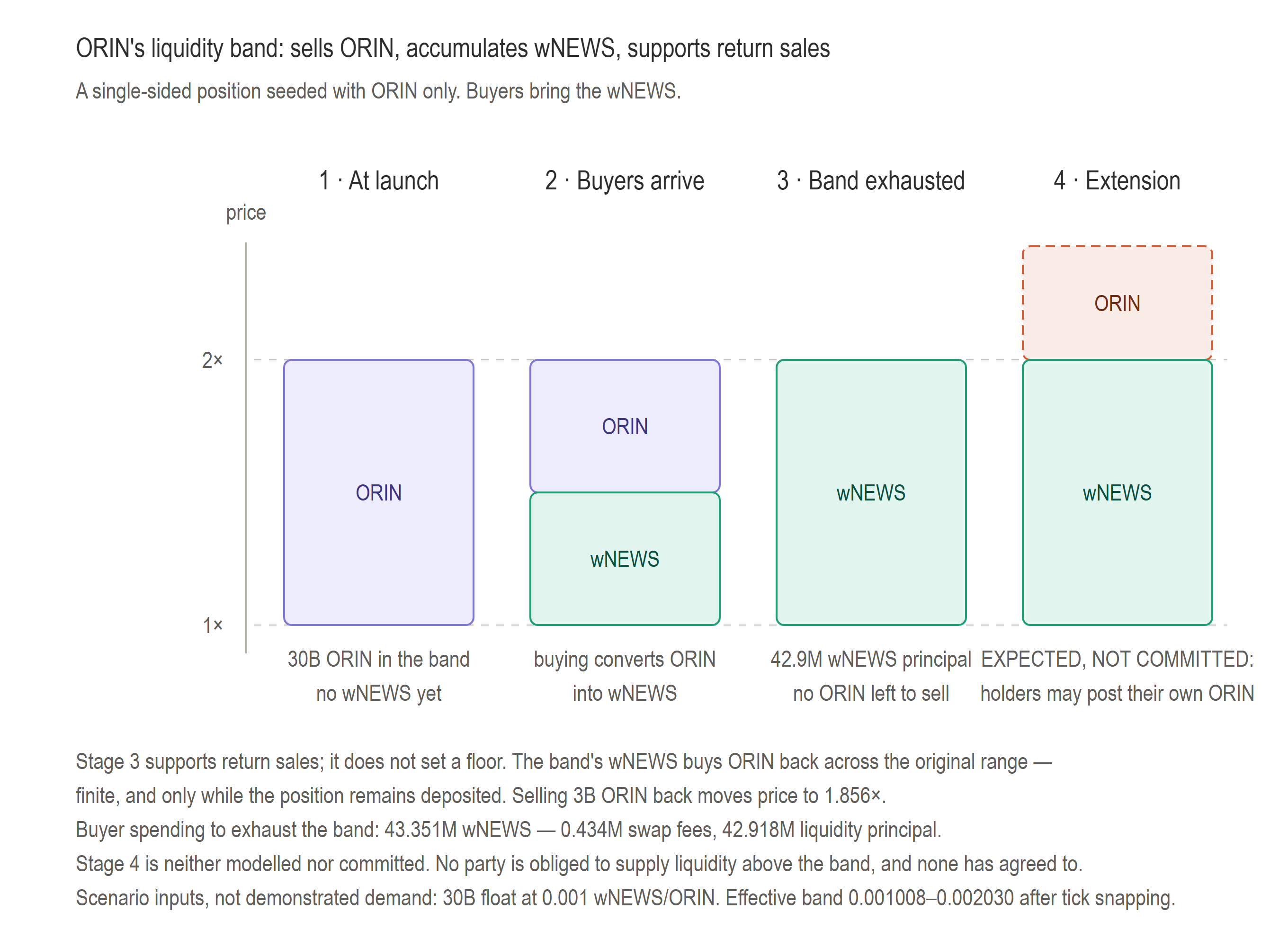
Selling 10 percent of the launch float back from the upper boundary produces an approximately 7.8 percent decline in the simulated marginal price. That is one defined scenario. Additional positions, alternating trades, withdrawals and changing market conditions can produce different outcomes.
The study’s 100 million wNEWS fleet balance and 30 million demand anchor are inputs. Available wallet balances do not demonstrate purchase commitments. Price is denominated in wNEWS; the calculation does not assume a stable dollar value for wNEWS. [3]
Why a 2 times band
The study compared six widths at the same float and price. A 1.5 times band would be exhausted only 7.3 million wNEWS beyond the 30 million demand anchor, so a modest underestimate of demand would empty it at once. A 10 times band would need 96 percent of the modeled fleet balance to exhaust and behaves as a price-discovery curve more than a sale. A full-range position never empties, sells 50 percent of the float at the anchor and moves the price to 3.93 times launch on the same demand. The 2 times band sits between them: the anchor moves its price to 1.66 times launch and leaves 13.4 million wNEWS of headroom before exhaustion. [3]
The recommendation is sensitive to the price input. At 0.002 wNEWS per ORIN the same band would take 87.3 million wNEWS to exhaust, 87 percent of the modeled fleet balance. [3] The study’s own text describes the exhausted band as a floor. The reviewed diagram corrects that wording and this paper follows the diagram: the band’s wNEWS supports return sales, it is finite, and it exists only while the position remains deposited. [19]
What the contracts enforce
One launch call is atomic. It deploys the fixed-supply token with every allocation minted to its final holder, creates the pool at the caller’s price, deposits the liquidity tranche as ORIN only, and sends the position to a named recipient. The call reverts if the pool was already initialized at another price, if any wNEWS would enter the position, or if the factory would be left holding a balance. Only wNEWS can be the quote asset. Only the factory’s owner can launch. [18]
The holder of the position can reduce its liquidity and collect at any time, which withdraws the unsold ORIN and any wNEWS received. That is the mechanism behind the phrase while the position remains deposited: the support for return sales lasts as long as the holder leaves it there. Who will hold the position is not decided. [16, 18]
The contracts are full contracts and not minimal clones, by decision. They exist in a local repository with no remote copy, and have not been deployed. No audit is recorded in any source read for this draft. The fork tests that gate an audit need an archive node address that has not been configured, and the launch script still sets a full-range band and needs a width input before it can produce the agreed ticks. [3, 16, 18]
Liquidity beyond the first band
Once the band is exhausted the pool holds no ORIN at any price. Holders are expected to be able to provide additional ORIN liquidity above the initial band. That is an expectation. It is not modeled, no party is obliged to provide it, and none has agreed to. The October 3 record settles the description in those terms: expected from holders, not committed by anyone. [16, 19]
The earlier bounds study recommended preparing a second ORIN-only position from a treasury or reserve tranche. That remains the study’s recommendation. It is not adopted here, and it would depend on an allocation that is not fixed. [3] This draft therefore describes neither a treasury release commitment nor a guaranteed holder extension. Whether any response to exhaustion is prepared before launch is an open question for the owner.
The supplied engine reproduces the study’s principal figures. The owner reports four tests against real Uniswap V3 bytecode in both sort orders, 12 parity tests against a frozen upstream engine and 30 passing tests in the main suite. The review reproduced calculations with the supplied engine; that run is not a third independent implementation. The underlying test files and logs should accompany a launch verification package. When read on October 3, the raw output file the study names held the 0.002 sensitivity run and not the 0.001 study, so the figures above are those printed in the study and the reviewed diagram. [3, 4, 19]
6 Implementation and launch readiness
Draft 0.2 described the network’s surfaces from documentation. This revision replaces that description with a check and separates what is in production from what is in a repository or a document.
What is in production
The site is served by a Cloud Run service named oralinsulin in project bondswipe-ts, region us-central1, on revision oralinsulin-00012-hx6, last deployed on September 18, 2026 under its own service account. [16] On October 3, 2026 the following were observed at oralinsulin.org. The site returned 200. The A2A card returned 200 and identifies itself as the OralInsulin Network evidence layer, version 1.1.0, read-only and category-neutral, with 15 skills. The MCP endpoint rejected a bare POST with 406, which shows the route exists, and answered a well-formed request for its tool list with the same 15 tools. The path /daily-summary.json returned 200 with a run generated that morning covering seven regions. The path /runs/latest.json returned the application’s own JSON 404. The path /healthz also returned 404, but from the hosting platform and not from the application: the response is the platform’s generic error page, and the same route with a trailing slash returned 200 from the application. [16, 17]
What is in the repository
The implementation is in a private repository, FludAI/oralinsulin-mcp, with a working branch named astra-analyst. The October 3 location record, as first generated, stated that there is no local clone and that the running source cannot be read, and it inferred from the /healthz result that the deployed build predates the repository. Both points were re-checked for this draft and neither holds; the record now carries a dated correction. A clone exists on the same machine, at the path the codebase map names, on that branch, with a clean working tree and level with its remote. The repository registers /healthz, and the live 404 on that path never reaches the application. [13, 16, 17]
Production and the head of the repository agree wherever the two can be compared from outside. The application’s 404 message in production matches the server file word for word. The card version is the same, and the same fifteen tools are registered. The running revision was built from a source upload made at 12:46 UTC on September 18, 2026, nineteen seconds after the last commit that touches server or pipeline code; every later commit changes documents only. A source upload carries no commit identifier, so identity with a commit can be shown to be consistent and cannot be proven. The codebase map cited by Draft 0.2 is dated September 13 and documents four tools with others planned. It is an earlier description of the same repository, and both the repository and production have moved past it. [13, 17]
Three distinctions still matter. A tool that is listed is not thereby a capability that works: the three ledger tools are listed in production and answer that no ledger is available. The ledger code is in the repository, and the vision states that the separate estimator job runs an older image and must be rebuilt before it writes one. A route that is proposed is not live: /runs/latest.json exists only as a proposal in the map, while the daily output that is live is /daily-summary.json. A document in the research folder is not in the record: the candidate registry seed, the field evidence, the market band, the base rates and the impact-model design are drafts for owner review, and nothing deploys from that folder. [1, 16, 17]
| Component | In production, checked October 3, 2026 | In repository or documents |
|---|---|---|
| Public site | Live, 200 | Local clone at the branch head, level with its remote |
| A2A card | Live, 200; version 1.1.0; 15 skills | Version 1.1.0 at head |
| MCP endpoint | Live; 15 tools listed; bare POST returns 406 | The same 15 tools registered at head; the September 13 map documents four |
| Daily estimation output | /daily-summary.json live; run of October 3; seven regions | /daily-summary.json route at head; /runs/latest.json proposed in the map only |
| Health route | /healthz/ returns 200 from the application; /healthz is answered by the hosting platform with 404 | Registered at head |
| Ledger and run history | Tools listed; answer that no ledger is available | Ledger code at head; the estimator job runs an older image, according to the September 18 vision |
| Evidence analyst | Tool listed; not exercised in this check | Question and scenario-advice routes at head |
| Evidence review protocol | Not in production | Prototype script and September 18 report in the research folder |
| Candidate registry | Not in the record | Draft seed, 58 studies; classifications unverified |
| Impact model, break-even tool, market band | Not built | Design and drafts for owner review |
| Committed forecasts | None exist | Commit-reveal primitive built, according to the vision |
| Access tiers and keys | None | Planned |
| Valuation workbench consumption | Integration not established | Repository access granted; no analysis shown |
| ORIN token and launch factory | Not deployed | Local repository, 30 tests passing, no remote copy, no audit recorded |
| ORIN launch band | Not deployed | Simulated proposed configuration |
| ORIN staking and rewards | Nothing exists | No contract; inferred scheme in section 4 |
Repository access was enabled so Viability could read the implementation. Access does not establish that an analysis occurred. The proposed /runs/latest.json output would carry estimates and usage counts for valuation work; the vision separately mentions /daily-summary.json. As of October 3 the second exists in production and the first does not. The final release must identify the actual output, its schema and any consuming integration. [1, 13, 17]
Open questions this draft does not answer
The following bind money or identity and are left to the owner. None is inferred anywhere in this paper. [16, 19]
| Question | State on October 3, 2026 |
|---|---|
| Launch price in wNEWS per ORIN | Not decided. The study assumes 0.001 throughout. |
| Allocation of the supply | Not decided. The written split of 54 billion, 23 billion and 22.9 billion is marked draft; it accompanies a 0.1 billion liquidity tranche and cannot coexist with a 30 billion float. |
| Addresses | Not decided: the ORIN wallet, the factory owner, the allocation recipients and the holder of the liquidity position. |
| Liquidity above the band | Expected from holders. Not committed by anyone. |
| Response to exhaustion | The study recommends a second position; no source of ORIN for it is decided. |
| Audit | None is recorded. The fork tests that gate an audit await an archive node address. |
| Names | orin.base.eth is registered for one year, to October 3, 2027. oralinsulin.base.eth is registered for ten years. Neither points at a contract yet. |
| Named verifier for candidate classifications | Not decided. |
Inferred dependency, derived from the vision’s build order [1] and the custody position in section 4: the bond and reward scheme records its commitments in the ledger, pays from access fees and scores committed forecasts. It therefore cannot be exercised before three items on the existing build order are done: the estimator job rebuilt so that production writes the ledger, access tiers on the MCP, and the first committed forecasts. Token work that precedes those is launch work only.
Limits and responsibilities
The network reports evidence and computes stated scenarios. It does not prescribe treatment or issue its own efficacy or safety conclusions. Large disease burden, successful analog markets and adjacent licensing transactions do not establish candidate success, project traction or ORIN value. Prospective partners remain prospects until a qualified interaction is recorded.
Launch disclosures must state the final supply, allocation, vesting, authorities, deployed addresses, liquidity ownership and withdrawal permissions. The 30 billion float is listed as agreed; the rest of the allocation, its vesting and its recipients are not, so no supply schedule is confirmed. Planned staking functionality must remain identified as planned until implemented and verified. [16]
The next milestone
The first milestone is an operating network with a reproducible public evidence record and a correctly disclosed launch market. The next is a defined ORIN participation mechanism that connects accountable work to compensation. Over time, the network can earn trust through corrections, useful analysis and a scored record of predictions. Its purpose remains to measure and coordinate progress toward effective oral insulin, whichever developer achieves it.
References and document basis
Primary sources checked October 3, 2026 are identified below. Project documents retain their own dates and draft status. The recent evidence refresh is used for the network’s reported activity and classification discipline, not as independent confirmation of every linked clinical or regulatory claim. References 15 to 34 were added in Draft 0.3. External sources among them were not reopened for this revision; each note says how and when the figure was read and whether it passed the agent review.
[1] OralInsulin VISION.md. Owner direction captured September 18, 2026. Category scope, evidence rules, layers, ledger status and agent review protocol.
[2] Oral Insulin Evidence Refresh. September 28 to October 3, 2026. Supplied as Pasted markdown(4).md.
[3] ORIN-BOUNDS.md. October 2, 2026. Proposed tick bounds, scenario inputs, sensitivity and reported validation.
[4] engine.mjs and orin-bounds.mjs. Supplied launch simulation. Review reproduction October 3, 2026.
[5] field-evidence-draft.md and candidate-registry-draft.md. September 18, 2026 research drafts. Corrections and unresolved fields retained.
[6] International Diabetes Federation. IDF Diabetes Atlas, 11th edition, 2025; global factsheet for 2024. https://media.idf.org/media/uploads/sites/3/2025/04/IDF_Atlas_11th_Edition_2025_Global-Factsheet.pdf
[7] market-band-draft.md; market-evidence-draft.md; ed-analog-draft.md. September 18, 2026. Conditional market scenarios and analog research, not approved forecasts.
[8] cost-model-spec.md. Direct product acquisition and route-associated cost methodology. Project specification.
[9] Bahraminejad S and Almoazen H. Sublingual and Buccal Delivery A Historical and Scientific Prescriptive. Pharmaceutics 2025;17:1073. DOI 10.3390/pharmaceutics17081073. https://pmc.ncbi.nlm.nih.gov/articles/PMC12389210/
[10] impact-model-design.md and base-rates-draft.md. September 18, 2026. Planned break-even model and stage-conditional reference classes.
[11] NEWS Protocol. wNEWS Pricing Predictive Information. Supplied whitepaper, market and contract snapshot June 27, 2026. Source of protocol direction; current deployment facts require refresh.
[12] Uniswap. Uniswap v3 Core whitepaper. Concentrated liquidity and conversion across ranges. https://app.uniswap.org/whitepaper-v3.pdf
[13] codebase-map.md and mcp-expansion-proposal.md. Implementation seams, repository access, proposed run output and expansion design. The map is dated September 13, 2026 and describes an earlier state of the repository; superseded for deployment state by [17].
[14] OralInsulin Network. https://oralinsulin.org. Live page assets retrieved October 3, 2026. Category-neutral positioning, participant groups and market-scope labels; underlying market sources not independently reverified in this revision.
[15] NEWS Protocol. NEWS Protocol Whitepaper (2026): AI + Blockchain + Community for Verifiable Financial Intelligence. Supplied PDF, 16 pages, file dated January 17, 2026. Source of this paper’s arc and of every derivation marked in italics in section 4. Describes the protocol on Tron; its deployment facts were not rechecked.
[16] WHERE-THINGS-ARE.md. Generated by inspection October 3, 2026, with the check behind each row. Live surfaces, Cloud Run revision, code locations, agreed and undecided launch items. Two of its rows were found incorrect on re-check: a local clone of the implementation exists, and the /healthz result does not show an older build. A dated corrections block was added to the file the same day and section 6 follows the corrected state.
[17] Live checks of https://oralinsulin.org made for this revision, October 3, 2026, 22:28 UTC. Status of /, /.well-known/agent.json, /healthz, /runs/latest.json, /daily-summary.json and POST /mcp; the MCP tool list; one call to get_changelog; the response bodies of the two 404 paths; a read-only description of the Cloud Run service; read-only inspection of the local clone of FludAI/oralinsulin-mcp at commit 6ed5e3e. The analyst tool was not called.
[18] CompanyToken.sol and CompanyTokenFactory.sol. ORIN repository, contracts directory, commit 3c2d275, read October 3, 2026. Local repository with no remote; not deployed; no audit recorded.
[19] band-lifecycle.svg and companies/orin.json. ORIN repository, read October 3, 2026. The reviewed diagram and its house wording; the token configuration, marked draft, with the written allocation split and name terms. The diagram was an untracked file in that repository when read.
[20] verification-report.json and field-claims-draft.json. September 18, 2026. First run of the agent review protocol on ten draft records, with the corrections log.
[21] Halberg IB et al. Efficacy and safety of oral basal insulin versus subcutaneous insulin glargine in type 2 diabetes. Lancet Diabetes Endocrinol 2019;7(3):179–188. https://pubmed.ncbi.nlm.nih.gov/30679095/ Read September 18, 2026 through [5]; abstract agent-verified in [20].
[22] Oramed Pharmaceuticals. Top-line results from the phase 3 trial of ORMD-0801, January 11, 2023, and the accompanying Form 8-K. https://oramed.com/oramed-announces-top-line-results-from-phase-3-trial-of-ormd-0801-for-the-treatment-of-type-2-diabetes/ Read September 18, 2026 through [5]; agent-verified in [20].
[23] Pfizer Inc. Form 8-K, Exhibit 99, third-quarter 2007 results, October 18, 2007; EXUBERA label, DailyMed. Read September 18, 2026 through [5] and [7]. The label statements are agent-verified in [20]; the exit charges were read on the filing page and were not part of the agent review.
[24] AFREZZA label, DailyMed; FDA approval letter, NDA 022472, June 27, 2014. Read September 18, 2026 through [5] and [10]. Label pharmacokinetics agent-verified in [20].
[25] Generex Biotechnology Corporation. Form 424B3 (2012) and Form 10-Q for the quarter ended January 31, 2020. Read on page September 18, 2026 through [7]; not part of the agent review.
[26] Efficacy and safety of Tregopil as part of a basal-bolus regimen in type 2 diabetes: a randomized, active-controlled phase 2/3 study (2022). https://pubmed.ncbi.nlm.nih.gov/36352762/ Read September 18, 2026 through [5]; abstract agent-verified after correction in [20].
[27] Safety and efficacy of an oral insulin (Capsulin) in patients with early-stage type 2 diabetes: a dose-ranging phase 2b study. Diabetes Obes Metab 2023. https://pubmed.ncbi.nlm.nih.gov/36378077/ Read September 18, 2026 through [5]; abstract agent-verified after correction in [20].
[28] Novo Nordisk A/S. Form 6-K financial reports for full-year 2025 (February 2026) and the first half of 2026 (August 4, 2026); investor presentation for the first six months of 2025, citing third-party list-price market data. Read on page September 18, 2026 through [7]; not part of the agent review.
[29] NOCDURNA label (2018), DailyMed; Novo Nordisk release on the approval of Rybelsus, September 20, 2019; Chiasma release on the approval of Mycapssa, June 26, 2020; Novo Nordisk release on completing the Emisphere acquisition, December 8, 2020. Read September 18, 2026 through [5]. The first two are agent-verified in [20]; the Emisphere record was escalated as partial; the Mycapssa release was not part of the agent review.
[30] BIO, QLS Advisors and Informa. Clinical Development Success Rates and Contributing Factors 2011–2020, February 2021. BIO, Biomedtracker and Amplion. Clinical Development Success Rates 2006–2015, June 2016. Report PDFs read September 18, 2026 through [10]; not part of the agent review.
[31] Khunti K et al. Clinical inertia in people with type 2 diabetes: a retrospective cohort study of more than 80,000 people. Diabetes Care 2013;36(11):3411–3417. https://pubmed.ncbi.nlm.nih.gov/23877982/ Abstract read September 18, 2026 through [7]; not part of the agent review.
[32] Boye K et al. Patients’ preferences for once-daily oral versus once-weekly injectable diabetes medications: the REVISE study. Diabetes Obes Metab 2021. https://pubmed.ncbi.nlm.nih.gov/33140575/ Abstract read September 18, 2026 through [7]; funded by the maker of the injectable comparator; not part of the agent review.
[33] data/tier2-route-burden.json. Staged September 10, 2026. Published route-burden figures, each in its own scope: Peyrot M et al., Diabetes Care 2010;33(2):240–245; Blanco M et al., Diabetes Metab 2013;39(5):445–453; Parker ED et al., Diabetes Care 2023;47(1):26. Transcribed from abstracts; not part of the agent review.
[34] Published enumerations of non-injected insulin programs: Heinemann and Jacques, J Diabetes Sci Technol 2009; Zijlstra et al., J Diabetes Sci Technol 2014; J Nanobiotechnology 2025, PMC11737240; Mastrandrea, Vasc Health Risk Manag 2010. Read September 18, 2026 through [10] with an automated reader. The lists overlap and none claims completeness.
Inferred positions in this draft
Every italic passage in the body is one of the positions below. Each is the drafter’s inference, offered so that the owner can accept, amend or reject it in a sentence. None is adopted. No position sets a price, an allocation, an address or a commitment of liquidity.
| No. | Where | Position | Derived from |
|---|---|---|---|
| 1 | Root cause | Corrections to the category’s record are under-supplied because producing one costs more than it returns to its producer. | NEWS root-cause argument [15], applied to five sourced observations |
| 2 | Economic value of acceleration | The network’s foresight is estimated as Brier skill against the sourced base rate. | Definition of α in the formal model [11]; Brier scoring in the review protocol [1] |
| 3 | Economic value of acceleration | ΔW splits into an earlier-arrival term and a reach-and-value term, kept in three separate accounts. | The ΔW expression of Draft 0.2 |
| 4 | Section 4 | Evidence bond per record, forfeited for avoidable error and never for reporting absence. | NEWS stake-and-slash [15]; first review run [20]; vision rule 1 [1] |
| 5 | Section 4 | Verification reward paid per audited verdict, symmetric in the verdict’s direction. | NEWS verification reward [15]; pay for audited accuracy, never approvals [1] |
| 6 | Section 4 | Participation pays only above a chosen accuracy; the forfeiture-to-reward ratio follows from that one number. | Positions 4 and 5; accuracy and growth in the formal model [11] |
| 7 | Section 4 | Outcome reward scaled by skill against the base rate; the lock equals the forecast horizon. | NEWS outcome reward [15]; Brier multiplier in the wNEWS contracts [11] |
| 8 | Section 4 | Gap bounties on named empty cells of the record. | NEWS improvement proposals [15]; the field review’s ranked gap [5] |
| 9 | Section 4 | Partner access paid in ORIN and routed to the reward reserve, not burned. | NEWS consumer fees [15]; fixed supply [18] |
| 10 | Section 4 | Outputs co-bond on their input records; fees flow upstream; attribution only outside the network. | NEWS propagation incentives [15]; ledger lineage [1] |
| 11 | Section 4 | Reward reserve fixed at launch and spent at no more than a fixed share per period. | Fixed supply [18]; allocation undecided [16] |
| 12 | Section 4 | An audited record lowers the required bond; loss of automatic publication suspends rewards. | NEWS reputation and calibration [15]; agent scoring in the vision [1] |
| 13 | Section 4 | Stake buys no weight in a verdict, no choice of verifier and no vote on a fact. | Departure from NEWS [15] required by the vision [1] |
| 14 | Section 4 | Bonds and rewards recorded in the ledger and settled by the owner’s systems before any staking contract exists. | NEWS roadmap phase 1 [15]; payment rule in the vision [1] |
| 15 | Section 6 | The scheme cannot be exercised before the production ledger, access tiers and first committed forecasts. | Vision build order [1]; position 14 |